
Well yesterday’s Monday Mystery turned out to be one of those “where is the missing blog post?” mysteries. Sorry about that. We’ve been knee-deep (sometimes literally) in sorting papers and other things as we move along the path toward moving out of the apartment by the end of the month. That isn’t leaving as much time for a blog post as I would like.
But to make up for it today, I’ll offer not one, but two tantalizing tidbits about English royalty.
First up, Richard III, who has so recently garnered all the headlines. An article in the British newspaper The Guardian says that recent DNA tests have revealed unexpected details about how Richard III might have looked, revealing that rather than the dark-haired king portrayed in paintings, he may actually have been a “blue-eyed blond.” The article has an artist’s conception of what that could look like:
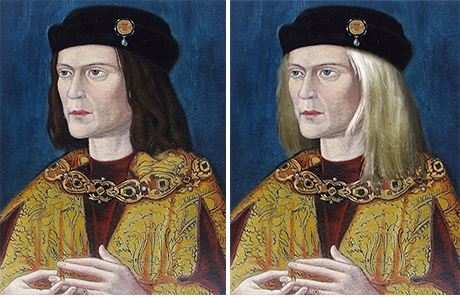
“Hair to the throne … King Richard III’s revised portrait with new golden locks ” – photo and caption from The Guardian
The article also talks about unexpected complications of some of the findings for the current Queen’s lineage claims:
Five anonymous living donors, all members of the extended family of the present Duke of Beaufort, who claim descent from both the Plantagenets and Tudors through the children of John of Gaunt, gave DNA samples which should have matched Y chromosomes extracted from Richard’s bones. But none did. … Since Richard’s identity was proved by his mitochondrial DNA, handed down in an unbroken chain through the female line from his sister to two living relatives, the conclusion is stark: there is a break in the claimed line of Beaufort descent, what the scientists described as “a false paternity event”, which may also affect the ancestry of their distant cousins, the Windsors.
I should admit I read this article a couple of months ago; if there are recent updates on the story, I haven’t run across them.
However, there was a breaking story today about one of Richard III’s predecessors, King John. Like Richard III, King John has been viewed across the centuries as a villain. Now you may recall that a recent trend has been to try to rehabilitate the legacy of Richard III, with people trying to paint him in a kinder light by shedding doubt on the story that he was responsible for murdering the little princes in the Tower of London, for example.
King John’s reputation had apparently undergone a similar rehabilitation relatively recently as well, with some historians trying to depict him as another ruler who really as bad as it seemed. This led to an historian making headlines today, though, by saying that research has revealed that Walt Disney in fact got it right when he made Prince (later King) John a villain in the 1973 cartoon version of Robin Hood.
This headline struck me as odd, though. For one thing, I must have missed the moment when King John was suddenly just a misunderstood king who really was kind of a nice guy. In my mind, he’s always been a bad guy, even if he wasn’t quite at the level of the notoriously murderous Richard III. After all, I’ve seen the 1938 movie The Adventures of Robin Hood. Prince John, before he becomes King, is certainly a rotten guy in that movie: he steals money and food from the poor, imprisons and tries to execute Robin Hood, his Merry Men, and Maid Marion, and plots and schemes to kill his brother, King Richard I.
So I would say that the 1938 movie — and not the 1973 version — is really the movie to point for getting historical basis for Prince John’s villainy right. If the 1973 has something similar, fine. But the movies did it first in 1938, so why talk about the historical accuracy of the 1973 cartoon?
I mean, after all, in 1973 movie, Prince John is not only a villain, he is a walking, talking, pratfall-taking lion.And I don’t think that’s historically accurate. I’m just saying.
A “false paternity event” — that should win some sort of prize for creative euphemisms.
funny how things go. You just can’t shake the past up and get something else, unless its fiction. Be that as it may, this false paternity event sounds interesting. I will see what’s up doc.
Thanks for the comments, Dovie and Kathy. “False Paternity Event” is a creative phrase, isn’t it. FWIW, another explanation of the implications of it in the British Royal Line can be found in another article here: http://www.news.com.au/world/paternity-result-from-dna-study-on-richard-iii-skeleton-raises-doubts-about-royal-family-lineage/story-fndir2ev-1227142762476.